If you are planning a corporate meeting, conference, awards program, association event or leadership meeting at a hotel, you may be told that the property has an “in-house,” “preferred” or “recommended” audiovisual provider.
That often leads to a very reasonable question:
Do I have to use the hotel’s AV company, or can I bring my own event-production partner?
The answer is usually more nuanced than a simple yes or no.
The short answer: sometimes you can, but the hotel’s rules control
Many hotels do allow outside audiovisual and production companies, but the exact requirements vary from property to property.
A hotel may require proof of insurance, vendor approval, specific load-in procedures, electrical or internet charges, house labor, rigging coordination, security requirements, equipment patch fees or other conditions.
A different hotel may have a more restrictive arrangement for certain services.
That is why the most useful question is not:
“Does this hotel have in-house AV?”
It is:
“Exactly which production services are we required to purchase from the hotel or its provider, which services can our own production company provide, and what rules or costs apply to each?”
That distinction matters.
A property can have a preferred audiovisual provider without every production discipline automatically becoming exclusive. Conversely, some services may be controlled by the property even when you are allowed to use an outside production company for the broader show.
The venue contract, property policies and event-specific requirements should be reviewed before you make assumptions.
Why the language can be confusing
Hotels use different terminology for their event-technology relationships.
You may hear terms such as in-house AV, preferred AV, exclusive AV, event technology partner, house rigging, house power, house internet or venue production services.
Those phrases do not have one universal operational meaning across every property.
One hotel may allow an outside production company but require advance approval and insurance. Another may let an outside team bring most production equipment while retaining control of rigging, power or internet. Another may require a house technician or fee to interface with certain installed systems.
Published property policies illustrate exactly that variation. The Mayflower Hotel publishes specific provisions for outside audiovisual companies, including hotel supervision during load-in and load-out, hotel-controlled power ordering, and waiver, insurance and operating requirements for outside vendors. Review the Mayflower outside-AV policy.
The right approach is therefore simple:
Ask for the actual policy.
“Preferred” does not automatically mean “exclusive”
This is one of the most important distinctions for meeting planners.
A preferred provider is a provider the property recommends or has a business relationship with. That word alone does not tell you whether an outside company is prohibited.
That does not mean planners should assume they are free to bring anyone into any venue. The applicable contract and property policy still control.
It means you should ask a more precise question:
Which services, if any, are exclusive?
That produces a much more useful conversation than arguing about whether the property has “in-house AV.”
What can still be controlled by the venue?
Even where an outside production company is permitted, the venue may regulate or control part of the event infrastructure.
Rigging
Hotels and convention centers can have their own requirements for overhead rigging, structural information, approved riggers, point loads, motors, truss, inspections and supervision.
Your production partner may design the event and determine what needs to be flown while the building connection or certain labor remains under venue control.
Electrical power
Large audiovisual systems, LED video walls, lighting systems and production areas can require substantial event power.
The venue may control electrical service, company switches, tie-ins, electricians or access to building distribution.
The production company should identify requirements early enough for the venue team to plan them correctly.
Internet and networking
Hotel guest Wi-Fi is not automatically the same thing as a production network.
Streaming, hybrid events, remote presenters, media distribution, show control or large attendee networks can require dedicated bandwidth, wired connections, custom networking or other venue coordination.
Ask who controls internet service, what can be ordered, whether bandwidth is dedicated or shared, where connections enter the room, and when testing can occur.
House audio, video and display systems
A venue may already have installed speakers, displays, projection, routing, scoreboards or broadcast infrastructure.
Sometimes those systems can become part of the production. Sometimes access is restricted. Sometimes use requires a house technician or a specific interface.
Jx2 can coordinate event-specific tie-ins with compatible venue systems when appropriate. See our Audio & Video Production capabilities.
Labor, access and loading
Hotels and convention centers can also establish rules around loading docks, freight elevators, move-in windows, storage, security, parking, supervision and required labor.
These details can materially affect the production schedule.
A technical design that works perfectly on paper can fail operationally if the room is not available until four hours later than the production schedule assumed.
10 questions to ask before signing the hotel contract
- May we use our own audiovisual or event-production company?
- Is the in-house provider preferred or contractually exclusive for any specific services?
- Are there outside-vendor, patch, supervision or access charges?
- What insurance, documentation or vendor approval is required?
- Who controls rigging, and what rigging labor or equipment must be obtained through the property?
- Who controls electrical power, tie-ins and distribution?
- Who controls internet, dedicated bandwidth and network services?
- Can our production company connect to installed house audio, video, display or broadcast systems?
- What are the real loading-dock, setup, rehearsal and strike windows?
- Are there required house technicians, union labor, security, engineering review or other production-related charges?
Ask for answers in writing where practical and make sure your production team receives the same venue documents.
The objective is not to create friction.
It is to understand the operating environment before the show design and budget depend on assumptions that may not be true.
When the in-house AV provider may be the right choice
An independent production company is not automatically the right answer for every event.
For a simple meeting requiring a screen, a few microphones and a straightforward program, using the onsite team may be efficient.
The house provider may already understand the rooms, loading procedures, installed infrastructure and venue staff. Those are real operational advantages.
There are also situations where sourcing something locally is more sensible than putting it on another truck.
A strong independent producer should be able to make that decision pragmatically.
When an independent production partner becomes especially valuable
The equation changes as the event becomes more complex.
An independent production partner can be particularly valuable when the project combines:
- general sessions and breakout rooms;
- LED or projection;
- cameras and IMAG;
- presentation playback;
- recording;
- streaming or hybrid workflows;
- lighting;
- scenic;
- staging;
- rigging coordination;
- rehearsals;
- graphics and content;
- executive presenters;
- awards programming;
- multiple venues or cities; or
- a recurring annual production.
At that point, the question is no longer simply what a microphone or projector costs.
Who is responsible for making the production work as one show?
Compare total production value—not just individual rental items
A line-by-line equipment comparison is useful, but it does not tell the whole story.
A professional event-production proposal may also account for pre-production, technical direction, project management, technical layouts, production schedules, venue coordination, playback preparation, rehearsals, cueing, specialist technicians, system testing, backup planning, troubleshooting and strike.
Two proposals can therefore list similar equipment while representing very different levels of production support.
For a corporate conference, executive meeting or high-visibility program, the lowest equipment subtotal is not necessarily the lowest-risk—or best-value—production plan.
You do not have to choose between “the venue” and “your production company”
This is where planners sometimes get trapped in the wrong framework.
They assume the outside production company and house provider must compete for every item.
They do not.
Jx2 approaches hotel and convention-center work as a coordination problem, not a turf battle.
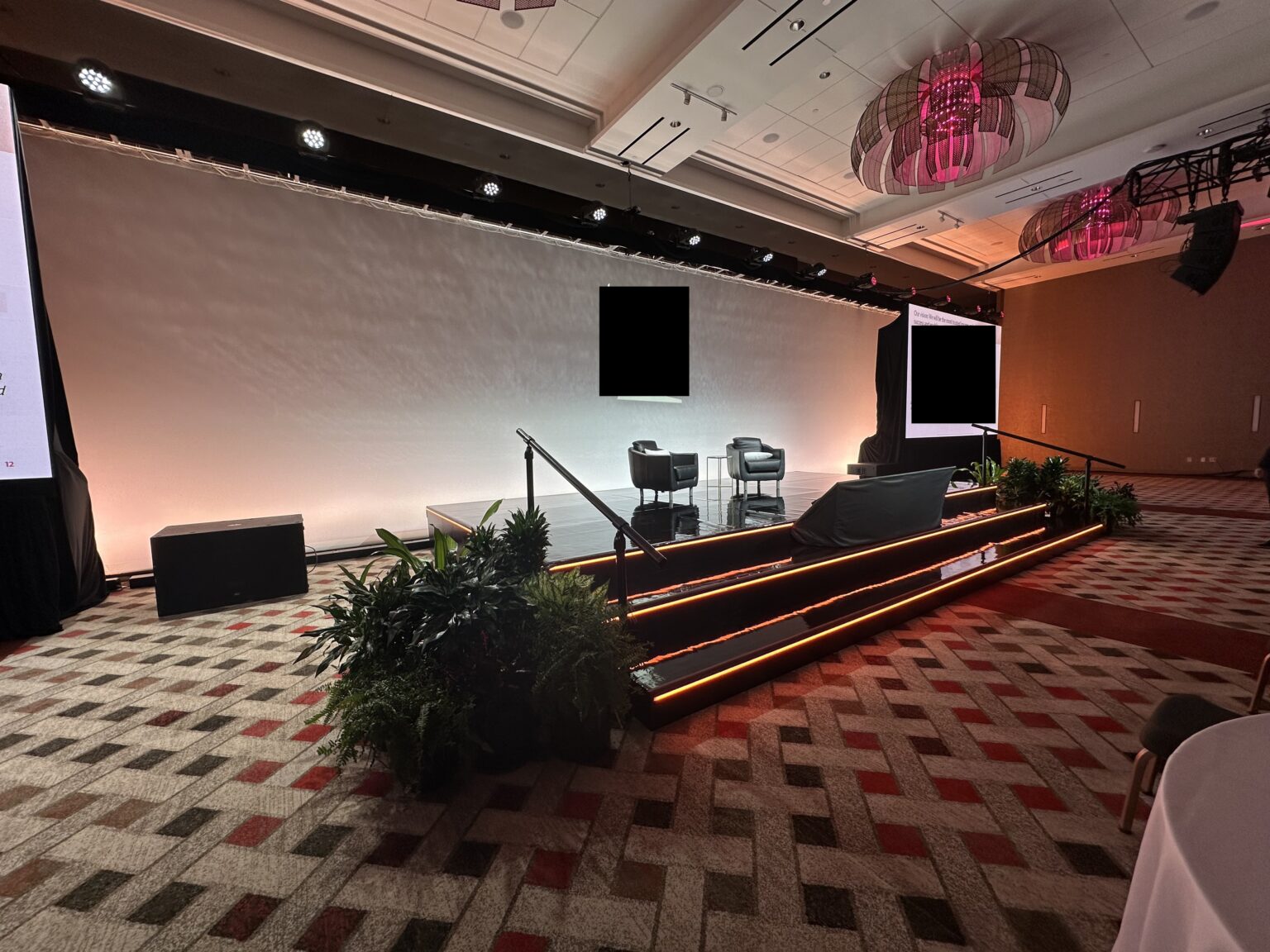
Depending on the property and event, the practical production plan might combine:
- Jx2 production leadership;
- Jx2 audio, video, LED, lighting, staging or scenic;
- venue-controlled rigging;
- venue power;
- venue internet;
- required house labor;
- installed venue systems;
- equipment sourced locally from the in-house provider; and
- other approved local vendors.
The objective is to assemble the right production for the client while respecting the venue’s rules.
One production point of contact can simplify the process
The meeting planner should not have to become the technical intermediary among every production discipline.
When authorized by the client, Jx2 can coordinate production requirements with venue and in-house teams, including technical scope, schedules, setup and rehearsal timing, rigging, power, internet, installed systems, local labor, local rentals and production-related pricing discussions.
Where a venue or house provider must bill the client directly, the client reviews and approves those charges under the applicable contractual structure.
Jx2’s job is to help keep the production pieces connected.
The best time to solve hotel AV questions is before the venue contract is final
Once a venue agreement is signed, your options may be narrower.
The earlier the production team can understand ballroom dimensions, ceiling conditions, loading, power, internet, stage position, sightlines, room access, rehearsal time, house-system availability and outside-vendor rules, the better.
That does not mean you need to completely design the show before choosing a hotel.
It means production should have a seat at the table during venue selection when technical requirements represent a meaningful part of the event.
For a deeper overview of that process, see Hotel & Convention Center AV Production.
Jx2 works with the venue—not around it
Jx2 Productions is a full-service live-event production company operating primarily from East Windsor, Connecticut, with an office in West Springfield, Massachusetts.
Our live-event capabilities include audio and video, LED video walls, event lighting, staging and rigging, scenic and drape, broadcast, streaming and related technical production, with New England coverage and nationwide support for appropriate projects.
Jx2 focuses on live-event production rather than permanent AV installation.
For hotel and convention-center events, the goal is straightforward:
Build the production around the event, understand the venue rules early, coordinate the required house services, and give the client one production team focused on the show.